
Every professionally financed feature film, television series, documentary, or streaming production begins with two critical documents:
A professional production budget.
A professional film finance plan.
Over more than 25 years producing studio and independent films, I have learned that investors rarely finance ideas, they finance professionally prepared productions.
A film finance plan demonstrates how capital will be raised, how production costs will be controlled, how financial risks will be managed, and ultimately how investors may recoup their investment.
Without that roadmap, investors are being asked to finance uncertainty.
Film Finance Plans For Film and Television Production
A professional film finance plan is a highly valuable asset for obtaining funding for your film or tv production. Film finance plans inform and advise investors about your film or tv series, the elements involved (story, team, cast, crew) and the detailed financials backing and substantiating the investment. Film finance plans compliment and are integral to our film budget preparation for feature film and tv series projects.
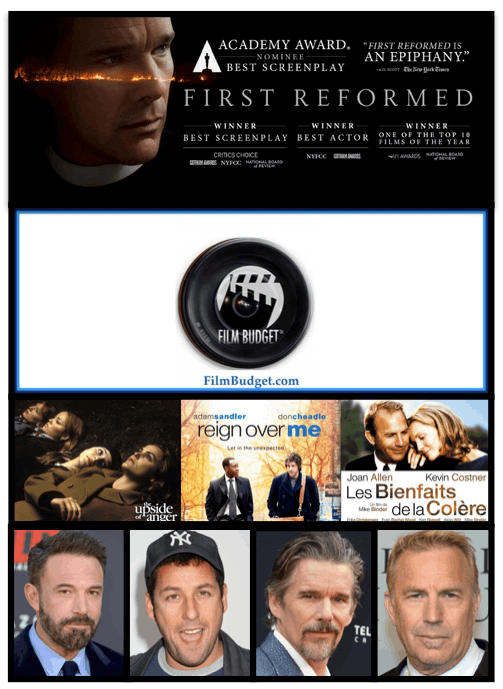
FilmBudget.com creates professional finance plans by 25 year veteran Major Hollywood Studio, indie film, and tv Producer Jack Binder ‘First Reformed’ Ethan Hawke, A24, ‘The Upside of Anger’ Kevin Costner, New Line Cinema, ‘Reign Over Me’ Adam Sandler, Columbia Pictures. A highly detailed film finance business plan custom created for you, for investors, film finance, distributors, international sales agents, completion bond, and film tax credits, for your film or tv production.
Over the course of producing feature films for major studios and independent productions, I have found that investors respond to finance plans that clearly demonstrate budget discipline, realistic production assumptions, risk management, and credible recoupment logic.
FilmBudget.com Producer Jack Binder creates custom finance plans designed for investment in your feature film or tv series production. Using his 25 years in the film and television industry as a Major Hollywood Studio and Independent Film Producer as well as a financier and an investor, Jack understand the requirements of film financiers, distribution, banks, financial institutions and investors.

Why Investors Require Professional Film Finance Plans
Whether the funding comes from private investors, banks, production lenders, distributors, sales agents, or completion bond companies, every serious financing source asks a version of the same questions:
– Can this project actually be produced?
– Can it be financed?
– Is the budget realistic?
– Is the schedule realistic?
– How will production risk be controlled?
– How will investors recoup their investment?
A professional film finance plan answers these questions by showing how the project will be funded, how capital will be managed, how financial assumptions were developed, and how the completed film may generate revenue.
Who Needs Film Finance Plans?
Investors, banks and distributors require investor-ready film budgets and accurate production finance projections. Filmmakers need a film finance plans to enable investment in their productions. Proper financial planning documents allow potential investors to understand your business model, and how they will recoup their investment.
Also known as a film finance business plan, or a film business plan, a business plan is a document that investors are accustomed to reviewing. Film financiers expect a filmmaker to have a roadmap for the finance, the production, distribution, and recoupment of investment.
Common Sources of Film Financing
Every film finance plan is unique. The financing structure depends on budget level, genre, cast, distribution strategy, target audience, and market conditions. Professional film finance plans often combine multiple funding sources to reduce risk and maximize production value.
- Private Equity Investment
- Film Tax Credits and Production Incentives
- Domestic and International Pre-Sales
- Gap Financing
- Distributor Advances and Minimum Guarantees
- Debt Financing and Production Loans
- Co-Productions
- Soft Money Programs and Regional Incentives
- Producer Capital Contributions
- Strategic Investment Partnerships
A successful finance plan demonstrates how these funding sources work together to fully finance production while creating a realistic path toward investor recoupment and profitability.
How We Create Film Finance Plans
Every finance plan we create begins with understanding the project itself. Our process typically includes:
1. Review the screenplay and production goals
2. Prepare or review the production budget
3. Analyze the shooting schedule
4. Evaluate film tax credits and incentives
5. Identify potential financing sources
6. Structure equity, debt, gap, incentives, and pre-sales assumptions
7. Model cash flow and financing timing
8. Prepare investor recoupment assumptions
9. Review risk, contingencies, and production realities
10. Prepare the final film finance plan for investor, lender, distributor, or production
Each production is different. Every finance plan is custom developed around the project’s budget level, financing strategy, production requirements, and intended marketplace.
What Information is Included in a Film Finance Plan?
Film finance planning created by Jack Binder contain a detailed and well organized description of all the important elements involved in the business model for the execution of a film production. Investors are very accustomed to reading business plans and know what to look for as indicators of a solid model in which their investment would be worthy of their funding.
Professional film finance and budgeting helps producers properly structure equity, tax incentives, pre-sales and gap financing.
The Key Elements of a Film Finance Plan:
- An introduction to the premise of the production
- Table of Contents
- Executive Summary:
- The Company which will be responsible for the production
- The Production which requires the funding
- The Team which will execute the plan
- The Cast that will be involved in the movie
- Plan of Distribution for the completed film
- How the investors will recoup their investment
- What is the current status of the market?
- Details of the industry
- Revenue projections to substantiate the financing
- Recoupment Plan & Recoupment Schedule
- Financial information relevant to the business plan
- Additional supporting documentation utilized in the projections
- Disclaimers as necessary
What is the FilmBudget.com Advantage
All movie business plans created by FilmBudget.com contain highly detailed creative and financial analysis of your film production. All finance business plans are created by the founder of FilmBudget.com, Producer Jack Binder. Binder is a seasoned veteran financier, executive producer, producer, line producer and Directors Guild of America Unit Production Manager (DGA UPM). Jack’s Credits can be found here.
Detailed production budget breakdowns are essential for lenders, completion bond companies and international co-productions.
Example Film Finance Plan Structure
A professional film finance plan demonstrates exactly how a production intends to secure the capital required to complete the project. While every production is unique, an independent feature film may utilize several financing sources working together.
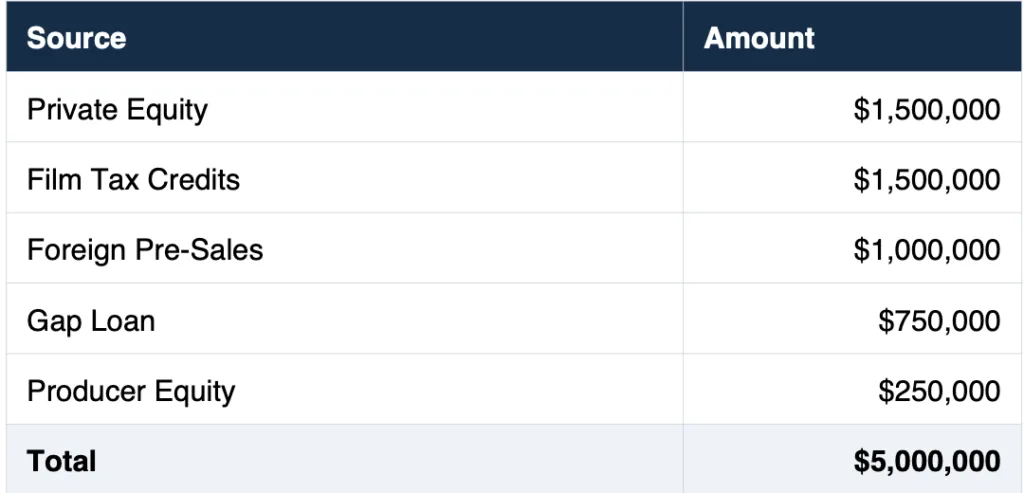
For example, a hypothetical $5 million feature film might be financed through:
- $1.5 million Private Equity Investment
- $1.5 million Film Tax Incentives
- $1.0 million Foreign Pre-Sales
- $1.0 million Gap Financing
The role of the film finance plan is to explain how these funding sources interact, how production costs will be controlled through a professional film budget and schedule, and how investors may recoup their investment through distribution revenues and other income streams.
Investors, lenders, distributors, sales agents and completion bond companies often require a clear understanding of the proposed financing structure before committing to a project.
What Makes a Professional Film Finance Plan Credible?
A professional film finance plan is far more than a business plan or financial summary. It is a practical financing roadmap built upon realistic production assumptions, detailed financial analysis, and an understanding of how films are actually financed.
Professional investors, lenders, distributors, completion bond companies, and production partners expect a finance plan to be supported by a credible production budget, an achievable shooting schedule, realistic financing assumptions, distribution strategy, film tax incentive analysis, investor recoupment modelling, and careful evaluation of production risk.
A finance plan is only as strong as the information supporting it. Without an accurate production budget and schedule, financing assumptions become speculative rather than practical. Professional film finance planning integrates all of these elements into a cohesive strategy that investors can evaluate with confidence.
A credible professional film finance plan typically includes:
• realistic production budgeting
• achievable scheduling
• practical financing assumptions
• investor recoupment strategy
• production risk analysis
• distribution planning
• film tax credit analysis where applicable
• contingency planning
Film Finance Sources
Private Equity
Private equity investors provide risk capital in exchange for an ownership position, profit participation, or negotiated investment terms. Equity is often the most flexible but also the most scrutinized source of capital.
Film Tax Credits and Production Incentives
State, federal, and international incentives can reduce net production costs and may become collateral for financing. Accurate qualified-spend projections are essential.
Domestic and International Pre-Sales
Pre-sales are distribution agreements made before production or delivery. They may support financing when backed by credible sales estimates, cast, genre, territory value, and distributor commitments.
Gap Financing
Gap financing may fill the difference between confirmed financing and the total production budget. Lenders usually evaluate sales estimates, tax incentives, collateral, and the project’s overall finance structure.
Distributor Advances and Minimum Guarantees
A distributor advance or minimum guarantee can provide capital based upon the distributor’s expectation of future exploitation rights.
Debt Financing and Production Loans
Production loans may be secured by tax credits, pre-sales, contracts, or other collateral. Lenders analyze risk, documentation, schedule, budget, and repayment sources.
Co-Productions
Co-productions can combine financing, incentives, creative partnerships, and territory-based resources across multiple jurisdictions.
Soft Money and Regional Incentives
Soft money includes incentives, rebates, grants, and other non-equity sources that may reduce the net cost of production.
Producer Capital Contributions
Producer investment can help demonstrate commitment but should be structured carefully within the overall financing plan.
Strategic Investment Partnerships
Strategic partners may participate for reasons beyond financial return, including brand alignment, distribution access, social impact, or content ownership.
How Do I Begin?
Get in contact with us via our Contact Page
We provide a free consultation to discuss your movie or television production. In conjunction with our core film budget services we can create a custom film budget and schedule package for you, or use one that you have already created. Our film budgets are detailed, accurate and proven with 25 years producing for the major studios, mini-major and indie film companies, worldwide. All of our budgeting services are finance and camera ready, meaning they are of exceptional detail and accuracy.
Please visit our Services page for full details and information on what our film budget and schedule packages contain. Click Here
We look forward to assisting you with an exceptionally well detailed film finance business plan which will allow your investors to understand the financials and intentions of your film production as relates to their financing and return of investment.
Visit our Home Page for additional information on our services which we provide to fellow filmmakers.
For more information on film financing have a look at the attached article:
“Producers, distributors and financiers are the primary players in US film finance”
Thank you and Good luck with your filmmaking goals!